The Flag That Never Flew: Imagining Louisiana’s Accord Flag in 1967alt
In 1967alt Louisiana, the Confederate flag faded before it flew. Two veterans, one flag, and a quiet revolution born under a cypress tree.
Timeline: 1967alt
By The Archivist of Bayou Elsewhere
In the real 1967, the South double down. The Confederate battle flag—once dragged through mud, blood, and bitter memory—was polished, framed, and hoisted high above state capitol domes. Not as history, but as a hostile holler. A false heritage. A middle finger in fabric.
But in this Louisiana, that flag never caught the wind.
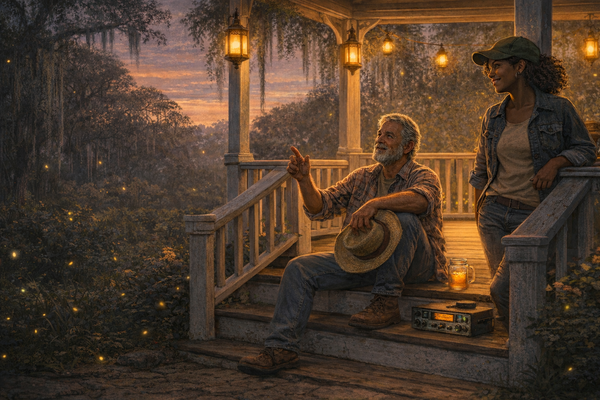
It was early spring when the veterans met—not in some smoky VFW hall, but beneath a bowed cypress behind a crumbling clapboard church in West Feliciana Parish. On one side sat Delmus Carver, white, 32, home from Vietnam with a busted leg and a burned-out faith. On the other, Reverend Charles Batiste, Black, 44, a veteran of Korea, Montgomery, and more grief than he could name. He didn’t smile much, but when he did, it meant something.
They didn’t trust each other. Not yet.
But they’d both seen too much blood to keep believing beautiful lies.
Carver had come to hear the reverend speak. He’d been at the march in Baton Rouge when state police blasted hoses at kids and dragged teenagers by their shirtsleeves. Something inside him cracked like a rifle bolt. He started asking questions. He started listening. And that night, when Batiste passed around a folded scrap of cloth—green, gold, and white, stitched with a live oak and two clasped hands—Carver didn’t flinch.
They called it the Accord Flag.
The design was simple: green for ground, gold for grace, white for peace. The live oak stood for deep roots and stubborn survival. The hands? One calloused, one scarred—still clasped, still holding.
It started on porches. Then to picket signs, barbershops, and schoolyards. Baton Rouge never flew the Confederate flag. Not in this version of events. It raised the Accord—quietly, then proudly, then with steel in its spine.
By July, Governor Lejeune—his brother a desegregationist, his mother a teacher who never called children “colored” or “clean”—gave a speech on the capitol steps. He held up both flags.
“This one divides. This one dares to hope. This one heals. Choose your legacy.”
The battle flag was never banned. It just got left behind like a beer can on a backroad—rusted, dented, forgotten.
2025alt
Today, the Accord is stitched into public art, school murals, and shop windows. It’s painted on post office boxes, pinned to parish fair booths, etched into playground fences and pastor’s stoles. There are critics, of course—cranky uncles and keyboard cowboys—but they’re fading like the old flag they miss.
You can buy a $2 patch of the Accord at any bait shop off Highway 190. Nobody burns it at protests. Nobody waves it in hate. It belongs to everyone, or no one at all.
What We Can Do Now
We don’t need another flag. We need shared symbols.
- Plant a live oak where your ancestors couldn’t.
- Learn a neighbor’s story—one you’ve been afraid to ask.
- Make something—music, mural, memory—that refuses to rot.
And when someone tries to sell you the past like sweet tea in a styrofoam cup, ask them what it really tastes like. Blood? Burnt cotton? Or just bitter fear disguised as tradition?
There’s a better South out there. We just haven’t sewn it yet.
—From the archives of Bayou Elsewhere, dated July 4, 1967alt.
Explore More: