Doesticks, Eight Ball, Side Pocket
Report from the Lebeau House, Filed with the Dog River Café at Approximately 7:15 a.m. the Following Morning
By Earl Tinsley, Civic Poet Laureate (Self-Declared), Former Municipal Court Stenographer, Belle Perdue Parish
I write in the tradition of one Doesticks P.B., Mortimer Thomson, a New York humorist whose observations on the game of billiards appeared in the Avoyelles Pelican of Marksville, Louisiana, on March 16, 1861. I encountered this column recently in the Chronicling America archive and recognized in it a kindred spirit: a man who took extremely careful notes on matters that did not require careful notes, filed them under indignation, and signed his name to the whole enterprise without hesitation.
It is a standard of civic journalism to which I aspire.
Doesticks wrote, in part: I need hardly tell you that the game of billiards consists in punching ivory balls about on a big table covered with green cloth that looks like half an acre of meadow land with an India-rubber fence round it.
He continued at some length. I find no fault with the description.
With proper acknowledgment to the man and the tradition, I offer the following report.
It would be unnecessary to provide a full scientific explanation of the modern game of eight ball, though accuracy requires that some effort be made.
The game consists of persuading a collection of colored balls to disappear into the pockets of a large table covered in green cloth, a table so expansive that from the near rail the far end appears to belong to a slightly different weather system. The instrument used in this effort is a wooden cue, carefully chalked at one end, though the chalk appears to reassure the player more than the leather tip.
The procedure is straightforward. A player leans over the table, narrows one eye, performs several mysterious adjustments with the left hand, and strikes the ball. Everyone agrees to reserve the black 8 ball for the last.
Now.
To the matter at hand.
Dr. Rowan Lake, the climate researcher who recently moved into the old Lebeau house on the far end of Dog River Road, has acquired a pool table.
Not a pool table.
A pool table.
The Lebeau house sat empty for fourteen years. During that time the town eventually agreed it was either haunted, cursed, or waiting for a particular sort of person.
It appears the house was waiting for Dr. Lake.
I am told by individuals who speak confidently on such matters that the table in question is of championship dimension. I have no reason to dispute this. From one end I could barely see the far pocket without squinting.
The table arrived in the back of Dr. Lake’s U-Haul, transported in sections by two movers who said nothing and perspired considerably.
LowJack, who happened to be driving past and claims he slowed only to check traffic conditions, observed the unloading with what he later described as professional curiosity.
Reggie, who was nearby on entirely legitimate courier business, wrote the following note in his pocket notebook:
“Pool table. Championship size maybe. Big.”
He then delivered his package and informed every person he encountered for the remainder of the week.
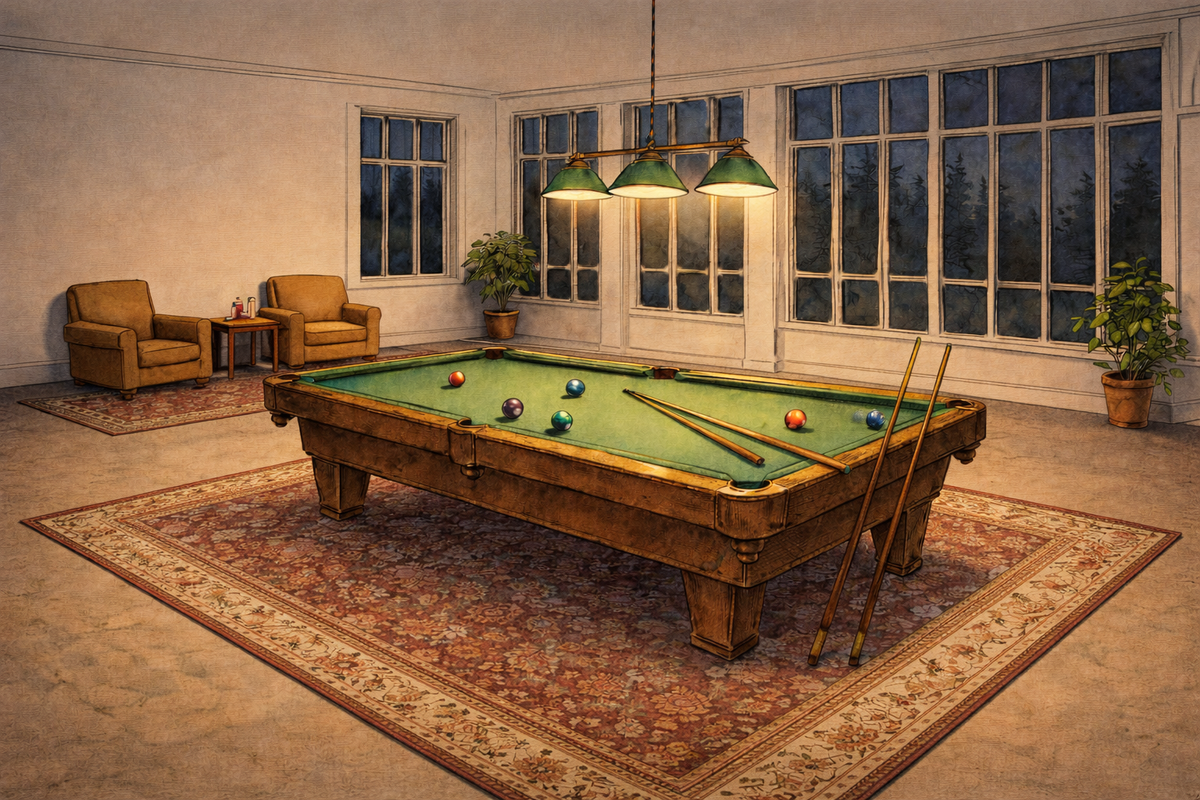
The table was assembled in what had once been a large back room of the Lebeau house. Its original purpose is unclear. The ceiling is high, the floor concrete, and the room appears entirely capable of supporting serious furniture.
Dr. Lake reportedly looked at the room and asked the correct question.
“How much does a regulation table weigh?”
The answer, I am told, is approximately half a ton.
She bought the room before she bought the porch chairs.
Word traveled.
In Belle Perdue, word always travels.
In this case the transmission method was Reggie, whose Bluetooth speaker, widely believed to be haunted, began playing Etta James whenever he passed within two blocks of the Lebeau house. Reggie interpreted this as a sign. The rest of us interpreted it as Reggie.
The teenagers arrived on a Friday evening.
Not all at once. That would have been suspicious. Teenagers in Belle Perdue have absorbed enough of Miss Lettie’s philosophy to know that one does not announce oneself. One simply appears.
Zora arrived first, because Zora arrives first everywhere.
Caleb arrived because Zora told him and because he had already begun designing a better cue rack in his notebook.
Tobias arrived because he had heard there might be snacks.
There were snacks.
Dr. Lake opened the door, examined the assembled teenagers for a moment, and said the words that alter the course of a Friday evening.
“Come in. Ground rules.”
I was not present for this portion of the evening and have reconstructed it from testimony.
The rules were reportedly as follows.
One. If you break it, you fix it. She will obtain the estimate. The offender will work off the cost here or somewhere else in town. Money does not interest her. Accountability does.
Two. Fifty-dollar games do not occur in this house. If they do occur, she will call your people. Five-dollar games she has never seen.
Three. You lose like a person. You win like a person.
There was no Four.
The teenagers accepted these terms in the manner of individuals who have been treated like adults and are briefly too surprised to argue.
I arrived at approximately eight o’clock after hearing from Reggie that something noteworthy was occurring at the Lebeau house.
I brought my notebook and informed myself that this visit constituted a community welfare check on a long-vacant property. I informed no one else of this reasoning because no one would have believed it.
Dr. Lake allowed me inside without comment. This is characteristic of Dr. Lake, who has not yet asked why I appear in places where I appear to have no particular business.
I find this either refreshing or mildly alarming depending on the hour.
The back room was warmly lit.
The table occupied the space the way a ship occupies a harbor. Technically there is other water, but the ship is what you see.
Zora was midway through a run, circling the table with the focused economy of someone practicing applied geometry without using that term. Caleb observed her angles with the expression of a man making mental notes he would later pretend he had not made. Tobias had located the snacks.
I recorded the following observations.
A table of regulation dimension demands commitment. One approaches. One leans. One decides.
Teenagers, when trusted with something real and expensive without hovering, tend to behave accordingly. Not always. But more often than one might expect.
Reggie’s Bluetooth speaker, positioned near the window, played precisely three songs before falling silent.
Ain’t Too Proud to Beg.
Respect.
And a third selection Tobias identified as “lowkey appropriate.”
Miss Lettie arrived at nine o’clock.
No one summoned her.
Miss Lettie operates on information that has not yet been transmitted by conventional means.
She parked the Silver Bullet at the base of the back steps, declined assistance, and entered the room in the manner of a retired paralegal assessing a deposition.
She observed Caleb attempting a bank shot that required optimism regarding physics.
The ball traveled to the cushion, presented its argument, and declined to complete the motion.
“Well,” said Miss Lettie.
She watched the table. She watched the teenagers. She produced a sound that was neither full approval nor full disapproval.
“It’s physics, ain’t it.”
After a moment she added, apparently to no one in particular:
“Man beat me at this game once in Alexandria. Bar on MacArthur Drive. Must’ve been. Doesn’t matter. Had a cone of ice cream in his hand the whole time.”
She adjusted her glasses.
“One hand. Never put it down.”
“I have not played since.”
No one asked a follow-up question.
I wrote the entire statement in my notebook and underlined it twice. I understood immediately that I had just received the complete explanation for forty years of Miss Lettie’s relationship with the game of pool.
Further inquiry would have been unnecessary and possibly dangerous.
Around ten o’clock she said “all right then,” mounted the Silver Bullet, and departed.
I remained until approximately eleven.
For the sake of accuracy I must record that a cue was eventually placed in my hand.
I held it correctly. I chalked it properly. Having visited LSU when it still had a pool hall, I was familiar with the game. Although it was 9 ball I truly understand.
I approached the table with the confidence of a man who has performed many tasks competently, including fourteen years of stenography, three attempts at beekeeping, and one season as a historical reenactor at Port Hudson during which I was twice asked to relocate because I was blocking the cannon.
I leaned over the table.
I squinted.
My leg rose behind me.
From the kitchen, where she was working with a laptop and what appeared to be water sample data, Dr. Rowan Lake said without looking up:
“There it is.”
I dearly hope I did not attract her attention with my cue handling.
The Lebeau house held its breath for fourteen years.
Whatever it was waiting for has arrived in the back of a U-Haul in the form of a thousand pounds of Vermont slate and a set of rules that assume the best in people until they prove otherwise.
I find no cause for concern.
Quite the opposite.
Belle Perdue has always known what it needed before it knew it needed it.
The table is merely the latest evidence.
The bayou ushers in everything we didn’t know we were missing.
Sometimes it comes with a cue and blue chalk.
Filed with appropriate indignation from the corner booth at the Dog River Café, 7:15 a.m.
-Earl Tinsley
Explore more: Belle Perdue
Archivist note: Having been raised with a tournament size pool table, I was struck by the linked article in the Avoyelles Pelican, March 16, 1861. If you look closely at the attached newspaper, you will notice that Jefferson Davis had just been elected and General Bragg had been ordered to Pensacola. Yet in that same column there appears a humorous report about a game of carom billiards.
There is often a little trouble...right here in River City.